Top 10 Databases for Indian Research Scholars as per UGC Guidelines
A complete guide to trusted academic databases for researchers in India, ensuring credibility and quality as per UGC standards.
Introduction
When you start doing research, you always think about where to find information that you can really trust.
For people doing research in India, this is a big deal. The University Grants Commission (UGC), for short, says you have to use sources that are trustworthy and well-known. This means not everything you find online is good enough to use for research.
There is much new content coming out every day. This makes it hard to tell what is research and what is not trustworthy or even wrong. Even people who have been doing research for a time can get confused about which sources are okay to use.
This is where academic databases come in. They help get rid of the content and give you access to research that is good enough.
In this blog, we will talk about the University Grants Commission and ten databases that meet their standards. These databases can help you do research that you can really count on. The University Grants Commission is very important here, so we will make sure to follow their rules.
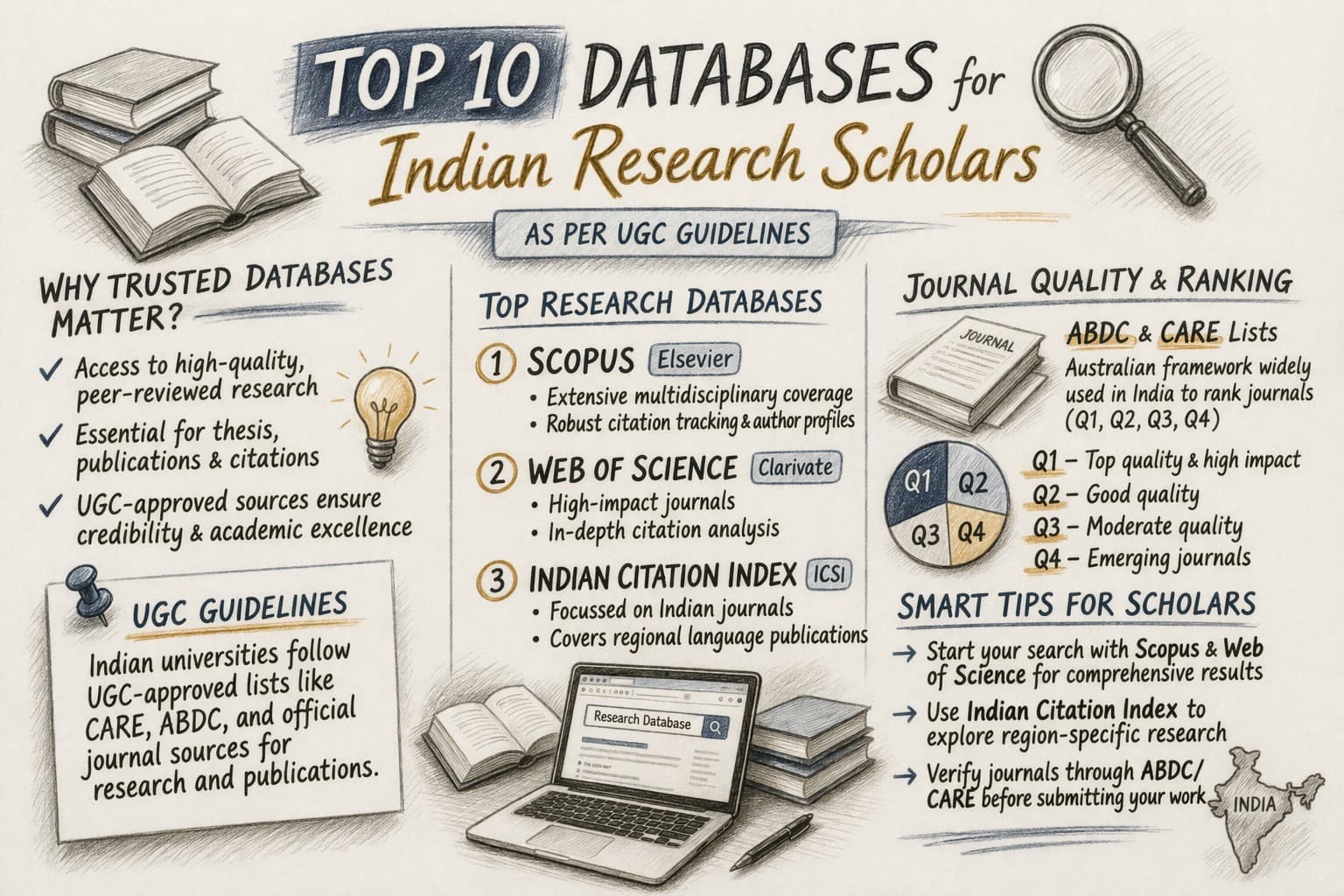
Top 10 Databases
1. Scopus
Scopus is a database that a lot of researchers use. It has a lot of journals that are reviewed by experts. This helps make sure the research in these journals is good. Scopus also lets scholars see how other people are talking about their studies around the world.
The University Grants Commission thinks Scopus is a source of information. Journals that are part of Scopus are usually seen as trustworthy. So they are a choice for researchers to use when they are writing papers or want to get their own work published. For researchers, Scopus is helpful because it supports research and helps their work get seen by more people in the academic community. Scopus is really helpful for researchers because it helps them get their work seen by people, and it is also a good place to find quality research.
For researchers, Scopus is useful not only for reading articles but also for understanding how research is used.
2. Web of Science
Web of Science is known for choosing journals. It only includes established and high-quality publications.
Web of Science matters for the University Grants Commission because it is recognized. Using journals from this database makes research more credible.
It provides a foundation for building good research.
ABDC Journal Quality List
The Australian Business Deans Council provides the ABDC Journal Quality List. This list helps researchers evaluate the quality of journals in business and management areas.
It is essential to understand that ABDC is not a database, but a list that ranks journals.
The ABDC Journal Quality List matters for the University Grants Commission because it is widely accepted. Publishing in ABDC-ranked journals makes research more credible.
The ABDC list classifies journals into the following categories:
- A* – Top journals, with the impact
- A – High-quality journals
- B – Standard journals
- C – Acceptable academic journals
Understanding Quartiles (Q1–Q4)
When people do research and look at journals in databases like Scopus and Web of Science, they often see something called quartiles. Quartiles are useful because they help you see how a journal is doing compared to journals in the same field.
Journals are divided into four groups:
- Q1 (Top 25%): These are the top journals. They are read by a lot of people, and many other researchers use the information in these journals. The people who review the journals are very careful. It is hard to get your work published in these journals. But very good for your academic career.
- Q2 (25–50%): Q2 journals have good standards. They are a choice if you want people to think you are a good researcher, and you want a lot of people to see your work.
- Q3 (50–75%): These journals are usually trustworthy and often focus on areas of research that are new or growing. Q3 journals are an option for researchers who are just starting to publish their work.
- Q4 (Bottom 25%): Q4 journals are often new or very specialized. They may not be as well-known as Q1 or Q2 journals, but Q4 journals can still be helpful, especially if you want to publish your research quickly.
Quartiles help you see where a journal stands. This can help you decide which journal to publish in and plan your research.
- Quartiles are a tool for researchers.
- Understanding Quartiles helps you plan better.
- Quartiles help you know about journals.
- They help you decide which journal to use.
3. Indian Citation Index (ICI)
The Indian Citation Index looks at journals that are published in India.
It is useful for researchers because the Indian Citation Index helps them find studies that are relevant to what they are doing.
The Indian Citation Index is also important for the UGC because the Indian Citation Index helps identify journals and the Indian Citation Index makes regional research more visible.
4. PubMed
PubMed is important for people who study medicine and life sciences.
It gives people access to updated research in the field of medicine.
This ensures that research is based on the scientific knowledge about medicine and life sciences.
5. ProQuest
ProQuest is a database that has journals, dissertations, and other academic content across many subjects.
ProQuest matters for UGC because it is used a lot in universities and gives people access to peer-reviewed content.
6. Google Scholar
Google Scholar is a place to start when you are doing research.
It helps you find articles, books, and citations quickly.
But Google Scholar does not filter out all journals, so you have to be careful when you use it to find research about Google Scholar.
7. Directory of Open Access Journals (DOAJ)
The Directory of Open Access Journals is really useful for people who want to read open-access journals that are of good quality. The Directory of Open Access Journals is free to use, so scholars can read research without needing to have a subscription through their university.
This is especially helpful when scholars cannot get access to the research they need through their university.
8. EBSCOhost
EBSCOhost is a website that has a lot of databases on it, and these databases are organized by subject. EBSCOhost has a lot of trustworthy information on many different subjects.
The search options on EBSCOhost are really advanced. It is easy to find what you are looking for without having to look through a lot of things that are not relevant.
9. ERIH PLUS
ERIH PLUS is a database that has a lot of information on the humanities and social sciences.
ERIH PLUS is committed to being open and to having academic standards for the journals it indexes.
ERIH PLUS helps scholars in these fields find journals that are good quality and that meet certain standards for research.
10. Embase
Embase is a database that has a lot of information on pharmaceutical research. Embase is really helpful for doing literature reviews and advanced research studies in the medical field.
It is an idea to use Embase along with other medical databases like PubMed because Embase has a lot of information that is not available in other databases.
Conclusion
Research is not about finding facts. It's about creating knowledge that people can believe.
Following UGC guidelines helps make sure research is good and honest.
These databases help researchers find sources to stay updated on the latest happenings and make their work better. Researchers should also check out programs like e-Shodh Sindhu and NLIST for access.
Good research needs choices, and picking the right database is one of them.
Final Thought
Good research requires good decisions at the end of the day. The selection of the appropriate database is one of such decisions that can determine the direction of your whole study.
Don't attempt to read; read the right things. This is what really matters to make research meaningful, original, as well as impactful.
Frequently Asked Questions (FAQs)
UGC takes into consideration the sources that are listed in such indexing databases as Scopus, Web of Science, and so on. These sites have peer-reviewed content and quality-checked journals, therefore enhancing the credibility of research.
A starting point will be Google Scholar, although this cannot be considered the sole source. It contains quality and poor-quality content, and thus, scholars need to confirm the indexing of the journal in reputed databases.
They are both trusted databases and are differentiated by coverage and journal selection. Scopus is more comprehensive, and Web of Science is more discriminating and pays attention to well-established journals.
Journals are split into quartiles depending on their contributions to a field. The highest ranking are Q1 journals, and lower ranking or newer ones are Q4 journals. They facilitate the selection of adequate journals by the researchers.
No, ABDC is not a database. It is a journal ranking list that is primarily applied in business and management research in an attempt to determine journal quality.
Yes, there are numerous articles in DOAJ that are credible due to their adherence to the standards of quality. Nonetheless, scholars are not to use or publish without verifying journal details.
PubMed offers reliable and recent research in the field of medicine and life sciences, which is why it is crucial in evidence-based research.
Indeed, the Indian journals that are registered in such databases as the Indian Citation Index (ICI) can be helpful, particularly when studying a particular region.
The ability to use various databases can allow a researcher to reach a broader scope of studies and compare results, and not omit valuable information.
It is based on your area of study. e.g., PubMed for medical research, ERIH PLUS for humanities, and Scopus / Web of Science for general academic research.